
Ecommerce platforms are no longer just online stores — they are distributed digital systems that must scale globally, integrate continuously, and evolve rapidly.
As organizations outgrow traditional platforms, a fundamental architectural question emerges:
Should we continue with monolithic commerce platforms — or move to composable commerce architecture?
This guide examines composable commerce vs monolithic platforms from a technical and strategic perspective.
“Architecture defines how fast your business can move.”
What Is Composable Commerce?
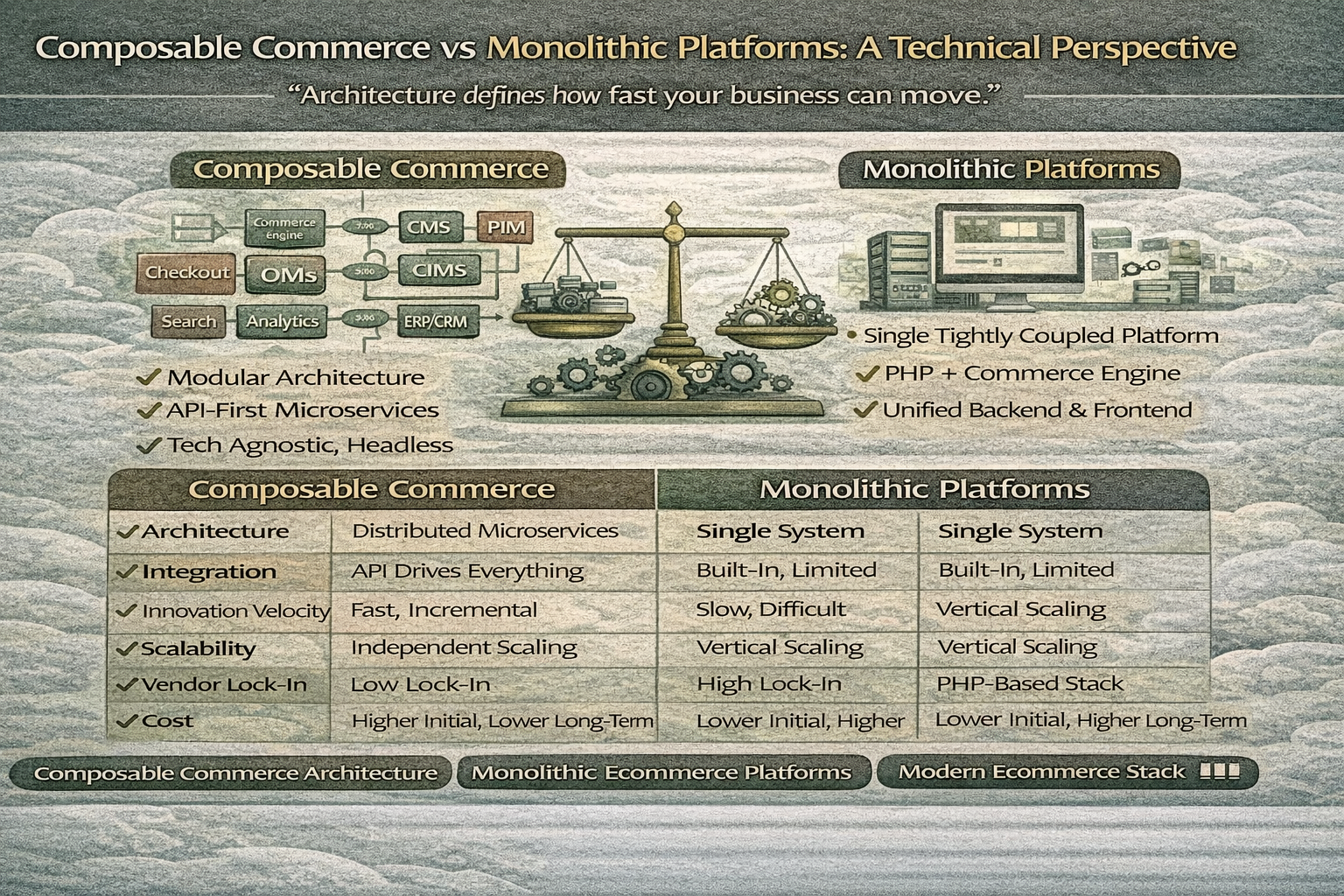
Composable commerce is an architectural approach where ecommerce capabilities are built as independent, modular services that communicate via APIs.
Instead of one large system, businesses assemble a stack using best-of-breed components.
Typical composable components include:
- Commerce engine
- CMS
- Search
- Payment services
- Checkout
- OMS
- PIM
- Analytics
Each component can be selected, replaced, and scaled independently.
What Is a Monolithic Ecommerce Platform?
Monolithic platforms bundle all functionality into a single tightly coupled system.
Examples include:
- Traditional Magento frontend
- Shopify themes
- Legacy enterprise ecommerce suites
In this model:
- Frontend and backend are connected
- Updates affect the entire system
- Scaling requires scaling everything together
“Monoliths simplify setup — but complicate evolution.”
Architectural Comparison
| Layer | Monolithic Platform | Composable Commerce |
|---|---|---|
| Architecture | Single system | Distributed services |
| Coupling | Tight | Loose |
| Integration | Built-in | API-driven |
| Scaling | Vertical | Horizontal |
| Deployment | Unified | Independent |
| Vendor lock-in | High | Low |
Composable commerce shifts architecture from platform-centric to service-centric.
Core Principles of Composable Commerce Architecture
Composable commerce is built on three core principles:
1. API-First
All services expose functionality via APIs.
2. Microservices
Each capability runs independently.
3. Headless by Default
Frontend experiences are decoupled from backend logic.
“Composable commerce treats ecommerce as a system — not a product.”
Development Velocity
Monolithic Platforms
- Slower release cycles
- High regression risk
- Tight dependency management
- Limited parallel development
Composable Commerce
- Independent team ownership
- Parallel deployments
- Faster feature delivery
- Reduced blast radius
Composable architectures enable true DevOps maturity.
Scalability & Performance
Monolithic Scaling
- Scale entire platform
- Resource inefficiency
- Performance bottlenecks affect whole system
Composable Scaling
- Scale only required services
- Edge-level performance
- Better traffic isolation
“Composable systems scale precisely where demand exists.”
Technology Flexibility
Monolithic
- Fixed technology stack
- Limited customization
- Vendor roadmap dependency
Composable
- Freedom to choose best tools
- Replace services without replatforming
- Cloud-native alignment
This flexibility reduces long-term technical debt.
Integration Strategy
Composable commerce excels in integration-heavy environments.
- ERP
- CRM
- OMS
- PIM
- CDP
- Analytics
APIs become the central contract between systems.
“In composable commerce, integrations are first-class citizens — not extensions.”
Operational Complexity
Composable systems introduce complexity.
Challenges
- Requires strong engineering governance
- Distributed monitoring
- API versioning
- Service orchestration
- Observability requirements
Monoliths are easier to operate initially — composable systems are easier to evolve long-term.
Cost Considerations
Monolithic Platforms
- Lower initial cost
- Faster time-to-market
- Lower engineering overhead
Composable Commerce
- Higher upfront investment
- Infrastructure costs
- Engineering maturity required
- Lower long-term replatforming cost
“Composable commerce costs more to start — less to outgrow.”
Security & Risk Management
Composable architecture improves security isolation:
- Smaller attack surfaces per service
- Independent access control
- Service-level authentication
- Reduced systemic failures
However, it requires stronger API security discipline.
When Monolithic Platforms Make Sense
Monolithic platforms are ideal when:
- Business is early-stage
- Speed to market is critical
- Team size is limited
- Customization needs are minimal
When Composable Commerce Is the Right Choice
Composable commerce architecture fits when:
- Business operates globally
- Multiple channels exist
- UX differentiation matters
- Integration complexity is high
- Long-term scalability is required
“Composable commerce is not for everyone — but it’s inevitable for enterprises.”
CTO-Level Decision Framework
| Question | Recommendation |
|---|---|
| Fast launch needed | Monolithic |
| Complex integrations | Composable |
| Enterprise scale | Composable |
| Limited dev team | Monolithic |
| Long-term flexibility | Composable |
Conclusion
The debate of composable commerce vs monolithic platforms is not about technology preference — it’s about organizational maturity and growth strategy.
Monolithic platforms optimize for simplicity.
Composable commerce architecture optimizes for adaptability.
For CTOs, the decision ultimately comes down to one question:
“Do we want a platform that works today — or an architecture that works tomorrow?”